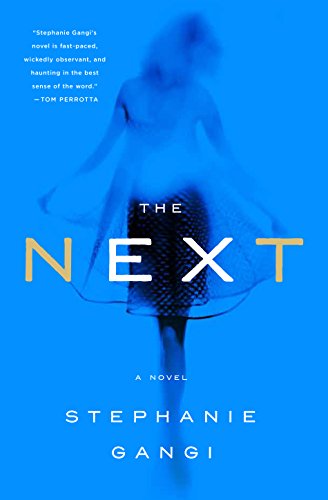
In honor of the paperback release of THE NEXT, one of Library Journal's Best Books of 2016, I am posting our earlier interview with Stephanie Gangi. You can find her lovely personal essay on this website.

SARETT: It’s hard to believe this is your first novel-- the writing’s so vivid. Had you written other novels before THE NEXT?
Gangi: Well, thank you, but No! I have made a dozen starts over the years, crates full of beginnings. I always knew I was a writer, but I spent much too long considering it my ‘hobby’. Crazy!
SARETT: Which came first for you -- the story or the character of Joanna?
Gangi: Joanna came first. I wanted to write about a complicated, complex woman, an angry woman who can not reconcile the disappointments that life delivers, and is determined to finally unleash her rage. I myself am not terribly angry (until the election, of course), or if I am, I manage to redirect or channel that anger, as many women have been trained to do. I wanted to to just let my Joanna rant against heartbreak, aging, sickness, invisibility, inevitability.
SARETT: The novel is about after-life, of a sort. Do you believe that we do experience “life” after death? That we have souls, for example?

SARETT: Many writers love ghost stories- and so do I! I’m a huge fan of Edith Wharton’s ghost stories. Were you a fan of ghost stories before writing THE NEXT?
Gangi: Honest answer is no, although Wharton is the exception. I thought the ghost concept was a strong metaphor, though, and the more I wrote into it, the more comfortable I became with it. Women of a certain age made invisible by society, existing outside reality when you are sick, technology harboring the ghosts of our many selves in the machines. And I loved the idea of a contemporary ghost in NYC, mingling with all the other ghosts, playing with how she would operate, how she would use her invisibility to take what she wants. Or thinks she wants!
SARETT: Your angry heroine did bring to mind the great Fay Weldon. Was she an influence in your writing? Any other style muses?
Gangi: Thank you for that! There’s a deep morality in her work, and a worldview that is tough and authentic and feminist. On top of that, she’s a satirist and funny, which is so hard to do. I’ve heard from readers that they’ve laughed out loud reading The Next, so if I’ve come close to Weldon stylistically, I’m thrilled.
As far as ‘style muses,’ I can only respond as a reader. I’ve been drawn to an ironical, cynical voice that thinly veils blinding passion and despair! I’m thinking of Heller, Vonnegut, Tom Wolfe, DeLillo, and an heir of theirs, the great Anthony Mara. Combine all that with my love of commercial fiction (Gone Girl comes to mind), and I’d say my “style” lies therein. I aspire, anyway.
SARETT: Joanna, your ghost heroine, is hell-bent on revenge-- and yet the object of her affections is a second rate guy. To me, that felt like a feminist statement (funny, but biting) about how much time women waste on unworthy men -- was that your intent?
Gangi: I’m not sure I was successful with the Ned character if he comes across as ONLY unworthy. I hoped to show that Ned is driven by his own demons – alcoholic mother, closeted dad, a deep-down romantic streak he tamps down for his ambition. It’s true that ultimately, he is a guy -- non-communicative, selfish, a survivor at all costs. Ned is aware of what he has lost and how he himself is responsible. I hoped he was redeemed somewhat by his awareness?
And yes, it was my intent to “use” Ned as a feminist’s foil … but also to show that Joanna was complicit. After all, she was pursuing vanity by getting involved with a younger guy, and on a deeper level – his desire helped her feel healthy. Stay alive. Helped her talk herself into believing their love could heal her.
I will say that the verdict is split. Half of my readers hate him, the other half are sympathetic to him.
And yes, it was my intent to “use” Ned as a feminist’s foil … but also to show that Joanna was complicit. After all, she was pursuing vanity by getting involved with a younger guy, and on a deeper level – his desire helped her feel healthy. Stay alive. Helped her talk herself into believing their love could heal her.
I will say that the verdict is split. Half of my readers hate him, the other half are sympathetic to him.
SARETT: Most novels have a mix of real and invented details? What’s the mix in THE NEXT?
Gangi: Maybe, 60/40? The outline is close: I’ve had breast cancer. I have a big dog. I live in Manhattan. My own parents died suddenly. I’ve been divorced. I have daughters. But, I have also had great men in my life. Sure, I’ve had disappointments, but I’ve not experienced the level of betrayal that Joanna does! Unlike Joanna, I’m a blessings-counter. Unlike Joanna, I have no doubt where love lies – I have two wonderful daughters, family and friends that support me and care for me, a world of love I could never neglect to tend to my fury. Unlike Joanna I try and take a hard look at my own part in life’s disappointments. What choices did I make that I don’t want to repeat? She doesn’t wake up to that until it’s too late.
SARETT: Lots of writing rules out there. Is there any writing rule that you secretly enjoy breaking?
Gangi: Yes! I did unleash an angry woman. I knew that would be controversialm and I was worried it would render The Next un-commercial. But the team at St. Martin’s embraced the book from the beginning, never once suggesting I tone Joanna down. Also, I alternated first and third person perspectives. I’ve heard from one illustrious editor that it’s almost impossible to do well, so I’m glad I stuck with the choice. I didn’t want a full-on rant to overtake the story. I needed to head-hop between characters, to show the impact Joanna’s death has on them. Grief is a complicated process – we don’t turn into saints when someone we love dies. We who are left behind remain our messy selves, and I wanted to show that through Jo’s daughters, Ned and even Tom, the dog.
SARETT: Humor is a tough game-- and there’s that saying death is easy, comedy is hard. How do you keep it funny?
Gangi: I think I am funny in real life. I can be irreverant and quick, maybe a little bawdy at times. I think life is funny, and people are funny, and even illness is kind of ridiculous. I think women are very very funny, and thankfully, recently, less afraid to reveal it lest men find it unattractive. I tried to channel all that, and then make it less specific to me, more universal. I’m glad you think I’ve succeeded! I wanted The Next to be funny and tragic. Like life.
SARETT: My blog readers are always looking for new books. Are there new fiction books that you’d recommend?
Gangi: These are my most recent reads:
Bad Marie by Marcy Demansky
A Constellation of Vital Phenomena: A Novel by Anthony Marra
The Underground Railroad by Colson Whitehead
Anna Karenina by Leo Tolsoy
The Last Samurai by Helen DeWitt
The Dovekeepers by Alice Hoffman
H is for Hawk by Helen MacDonald (nonfiction)
Barbarian Days: A Surfing Life by William Finnegan (nonfiction)
Citizen: An American Lyric by Claudia Rankine (Poems)
Citizen: An American Lyric by Claudia Rankine (Poems)
Find her:
Facebook: https://www.facebook.com/author.stephaniegangi/
Twitter: @gangi_land
Instagram: stephaniegangi
Buy the paperback at Amazon and if you enjoyed The Next, please leave a review on Amazon and/or Goodreads. They are so important for debut authors.