Showing posts with label Muriel Spark. Show all posts

Cause for Celebration: Virago

Those of us who are concerned with forgotten, neglected or generally under-valued female authors are grateful to Virago, the international publisher of books by women.  Through the efforts of Virago, we have been able to continue reading our favorite female authors like Daphne du Maurier, Muriel Spark, and others who, astonishingly, and frequently, are out-of-print or in watered-down editions. 


To celebrate its fortieth years, Virago is publishing special editions (with striking book covers) of several gems of the female canon:  Zora Neale Hurston's THEIR EYES ARE WATCHING GOD, Angela's Carter THE MAGIC TOYSHOP, THE DUD AVOCADO by humorist Elaine Dundy, FACES IN THE WATER by Janet Frame, THE WEATHER IN THE STREETS by the unjustly ignored Rosamond Lehmann, A VIEW OF THE HARBOR by elegant stylist Elizabeth Taylor, along with some better-known entries, like the wicked MEMENTO MORI by my idol, Muriel Spark, and HEARTBURN by Nora Ephron.  Even if you own a sad, dog-eared paperback, you might want to replace it with one of these lovely books, much as I've replaced my old Chandlers with Library of America editions.

But most enticing of all is a special essay collection, Writers as Readers: A Celebration of Virago Modern Classics.  I'm excited to hear what writers like Ali Smith and Claire Messud have to say about their favorites.  There's nothing quite as revealing about an author as the writers she admires -- whom do they compare themselves to?  who is on their bookshelf?  I fell in love with Muriel Spark when one of her characters admired Cavafy. Mystery writer Carol Goodman lured me with a mention of Muriel Spark. Yet, another author lost my affection when she confessed that she loathed Jane Austen.  Taste matters.         

Recommendations: Women's Scary Fiction for Halloween

I love scary stories of the literary variety .  As some of you know, I have flirted with ghosts in Nine Romantic Stories, in "A String Theory Valentine"-- and even wrote a "Happy Halloween" Tale that is now available in an Amazon anthology, 13 Bites.  What better way celebrate Halloween than reading some good old-fashioned spooky tales?  But for my money, some of the chillier chills come from women writers -- more inner demons and fewer of the flying variety, more psychology and less gore.

So here is my list for stories that sent some literary chills down my spine that make for perfect Halloween reading:

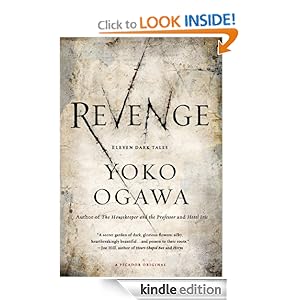
 Revenge by Yoko Ogawa.

These exquisitely dark tales by this contemporary Japanese writer are in the great tradition of weird and wonderful-- and I first learned of them through our own interview with Jessica Treat ( who recommended them.)  This author has a peculiar sense of the macabre that must come from the food they eat in Japan.  A woman buys a cake for a dead child, and another visits a museum of torture.  Spooky and fantastic.


Ghost Stories of Muriel Spark.
 I am a Dame Muriel addict, and gleefully devour everything she's written. And those familiar with novels like The Bachelors might be prepared for some dark, wild story-telling-- Spark always surprises.  But Dame Muriel also had a way with ghosts. It's fun to see her wicked prose tangle with the supernatural -- sometimes to comic effect, and sometimes to scary.  One of the best here is a first person narrative -- a lost ghost waiting to find her own death.


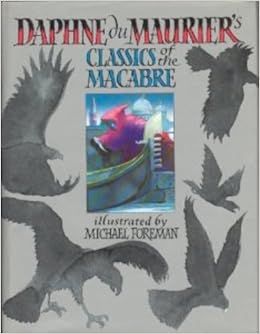
Classics of the Macabre by Daphne du Maurier.  

Mention Daphne du Maurier, and most people think of the Hitchcock films, The Birds and Rebecca.  Some may recall the Nicholas Roeg film, shot in Venice, Don't Look Now.  But the original stories, especially those in this volume, are far better than the films.  "The Apple Tree" is as frightening a tale of marriage gone wrong as any I have read -- and the original, "Don't Look Now" is lyrical, mysterious and terrifying.  I found this book in a gorgeous edition with illustrations by Micheal Foreman.


The Ghost Stories of Edith Wharton


This is another case of who knew?  Yes, it's the very same Edith Wharton who wrote The House of Innocence and Ethan Frome  (which as I think about it, is a very scary tale.) It turns out that Wharton had a flair for the classic ghost tale. I'm guessing that her affinity for Henry James (whose Turn of the Screw is one fantastic ghost story) led her to the genre-- but, read and you will see, she's no slouch.  Wharton loves the idea of old haunted houses, and she is great at those stories.  But to my tastes, her mastery is best shown in "Miss Mary Pask," in which the narrator falsely believes he is speaking to a dead woman and where "night and fog were now one." A perfect Halloween tale.


We Have Always Lived in the Castle by Shirley Jackson.

To me, this might be Number One on the all time spookiest books ever written.  Jackson doesn't need the supernatural to scare the living daylights out of you.  Her story of women who lock themselves into their own house is more frightening, more upsetting, than stories of demons or ghouls. Isolation is scary.  If any book can haunt you, it's this one -- and for years after you put it down.  

E-books and the freedom of short


By awarding Lydia Davis the Booker Prize, the publishing world admitted that shorter sometimes is better.  Writing isn't about word count.  I hope this sends a signal to authors that they can publish short books -- yes for less money, but with more freedom.

Movies and books today are...long.  They're struggling to prove value through length, with mixed results.  

Take movies.  Lots of older films clock in at 80 to 90 minutes. Characters zip from city to city, and viewers get the point. Films used to last as long as the story merited -- an epic was long, a screwball comedy short.  Now, they drag on for two long hours in which the director spoon feeds us every transition (gee, is that how he got to the airport?  I never would have guessed he drove!)  I've checked my email and not missed a beat.      

Books were often fat-- think, big fat nineteenth century tomes-- but they also could be skinny.  Dickens's A Christmas Carol: a long short story, and yet, what a story. Willa Cather's amazing Old Mrs. Harris and Muriel Spark's The Ballad of Peckham Rye--  are masterpieces of that forgotten form, the novella. They would be hard to publish in today's fat book world.

That's where e-books, Kindle Singles and self-publishing come in. My Nine Romantic Stories is only 20,000 words.  I could have made a fat book and included other stories.  But these stories fit together -- they're about men and women and relationships and love.  Mixed in with my others, they would lose their impact.  So it's a skinny book and I price it accordingly.  More recently, I published five funny flash fiction pieces in a "book" -- Crazy Lovebirds.Five Super-Short Stories.  Super-short doesn't work in print, but online, it's fun.

Some great "short" (and bargain-priced or free) reads that I have discovered recently:

Daydreams Story Sampler by Tim Woods -- three uber-romantic tales that won me over (and which I purchased for a "tweet" believe it or not).  I found this one on Goodreads.
First Kiss by Barbara Alfaro -- 25 poems in this lovely collection by a lovely poetess. Even if you don't adore poetry, you might like these.
Flash Fiction for the Cocktail Hour by Cathryn Grant, which has eleven delightful pieces of what the author terms "suburban noir -- it's one of several "volumes" of her flash fiction (gotta love flash fiction and volume together.)  I got this one for free, and I think it still may be free.
Watching Charlotte Bronte Die and Other Surreal Stories by Ellie Stevenson, which has some nice old-fashioned spooky tales, and a few quirky ones too.  Another Goodreads discovery.

Ten favorite books read if not written in 2012

No, this isn't a top 10 list of new books published in 2012.  It's a list of some of the books that I read during 2012, when I wasn't writing.  Some were pure inspiration, and some were literary models, but all are worth reading.

The Collected Stories of Deborah Eisenberg.  Eisenberg writes about loneliness as no one else can.  To me, she's what Salinger should have become.  Her world is close to Salinger's, but Salinger's truths are the truths of the young.  These stories are blessed with moments of transcendence, "as ample in mystery as the face in the moon."

Far Away and Long Ago by W.H. Hudson.  You may know Hudson from the magical romantic tale, Green Mansions.  He was also a superb naturalist and bird-lover, and one of the great writers ever.  I found this among my mother's books after she died, and only this year, read it.  Hudson grew up in Argentina, which was to him a bird paradise-- and he captures, without trying, the wild strange world of childhood.  As soon as I read one Chapter Heading, The Tyrant's Fall and What Followed, I was hooked.

Regrowth by Der Nister.  This story collection, from a Russian/Yiddish writer (recently translated from the Yiddish) contains masterpiece after masterpiece of life during and after the Nazi occupation.  Der Nister, I believe, translates as The Hidden One.  The stories are intricate and layered, and the meaning hidden beneath the narrative.  I've gone to sleep thinking about these characters.

Tales from a Greek Island by Alexandros Papadiamantis.  Few American readers know of this Greek author, and that is a shame.  Papadiamantis writes of the peasants on the Aegean Island of Skiathos, without any folksy sentimentality: the life's harsh, and the people more so.  Children fall into wells, unmourned; and brides are prized only for dowries. Each story speaks of an entire world, and not a a false note anywhere. [Note:  my Greek-speaking spouse alerts me that much is "lost in translation, but as with Chekhov, enough isn't.]

The Encylopedia of the Dead by Danilo Kis.    Another story collection, this time from a Serbian writer.  Kis is influenced by Borges, to be sure, but his take on magical realism is very much his own.  The stories have a dignity and an authority and a voice impossible to forget as seemingly cryptic symbols lead the author to childhood memories, haunted by the Holocaust.

Into the Silence by Wade Davis.  I've read many books about Everest.  But Wade Davis's re-interpretation of the Everest expeditions in light of the horrors of The Great War stands apart  Mallory becomes, heartbreakingly, alive once again in the book.  I wished, once again, that he had seen the summit.   I read this one twice.

Sacred Trash: The Lost and Found World of the Cairo Geniza by Peter Cole and Adina Hoffman.  I discovered this gem of a book through one of my favorite online resources. Tablet Magazine.  Just over a century ago, scholars discovered the "hidden" manuscripts of Medieval Jewry, some of which looked like shredded trash.  The scholarly hunt for this treasure is the subject of this lively book.  It's an adventure story of the mind.

Robinson by Muriel Spark.  This novella was unavailable ( more accurately, only available in expensive used editions) for years.  I was overjoyed to find it in City Lights Bookstore in San Francisco, and now it's again on Amazon.  It's one of Spark's earlier novels, and it's sharp and lyrical as only Muriel Spark can be-- strangers together on an unknown island, guided by the mysterious (and since its a Spark novel, perhaps evil) Robinson.  I read it once and then I started again. 

The Light that Failed by Rudyard Kipling. In a year of writing my romantic stories, I've returned to the great Romantics.  There's no better than Rudyard Kipling.  Why this novel's been forgotten is beyond me.  It's a novel about a painter, and visions of all kinds, and it's unforgettable. On Amazon, it's free as a Kindle edition.

Passion and Affect by Laurie Colwin.  Last December, my darling sister sent me a load of Laurie Colwin (who died at 40.)   They're all funny and compassionate and warm, and yes, entertaining.  This one's a charmer of a story collection, with the kind of stories that used to get published in women's magazines (not highbrow ones, either.) I'm in awe of her mix of serious and funny.


Marketing 101 revisited

Writing the stories for Nine Romantic Stories: Carla Sarett: Amazon.com: Kindle Store:  was wonderful.  I'd had luck getting the stories published in Erics Hysterics, Scissors and Spackle, Danse Macabre, InfectiveInk and The River Poet's Journal-- but submission to magazines is cut and dried.  The less you say in your cover letter, the better.  Either an editor loves what you write or she doesn't.  End of story.  No query letter required.  Easy-- and if you pick the right magazines, speedy too.  Some editors wrote me back the same day!

Getting agents and publishers, of course, is a slower business.  There were entire blogs dedicated to "writing a good query letter."  Yikes!  Not for me, thank you.

So, on to the world of self-publishing.  I'd worked in marketing (sort of) so I naively imagined that I'd navigate easily.  I knew in a remote sort of fashion that the readership for short stories isn't a big one.

How small is it?  I constructed a "Keyword Search" using Google Adwords using my favorite writers, writers like Allegra Goodman, Dawn Powell, Deborah Eisenberg, Laurie Colwin,  Muriel Spark.  Well, the total "reach" of all of those is neglible.  Even if I used ALL of them, Google's Adwords estimator informed me that I'd get ZERO clicks.  Zero, as we all know, isn't a good number.

With my marketing head, I could advise a writer -- do that search beforehand, and you'll get a sense of how big or small your market is.  But truth is, most writers don't write for money - I certainly didn't-- but we do write with the hopes of finding our readers. I'm not sure that self-publishing makes that process any easier than, say, writing that good query letter.


'via Blog this'
Related Posts Plugin for WordPress, Blogger...