Showing posts with label Rumer Godden. Show all posts

Student and Teachers: Female Novelists


Teaching's a great subject for novelists.  Goodbye Mr. Chips by James Hilton.  The clueless Paul Pennyfeather in Evelyn Waugh's comedy, Decline and Fall (whose obscure school is itself modeled on the school in Charles Dicken's inventive Nickolas Nickleby.)  The Utopian classroom of Louisa May Alcott's Little Men.  But the novels-- by female authors-- below stick in my mind.

Villette by Charlotte Bronte.  Bronte hated being a governess, but both her novels involve teaching -- Jane Eyre and then this odd novel in which a woman becomes a teacher by default, as it were, in a small French village, and falls in love with a cantankerous, charismatic "professor."  The heroine's choice of career seems arbitrary -- and yet it later feels like destiny.

Image result for Up the down staircaseThe Prime of Miss Jean Brodie by Muriel Spark.  Jean Brodie is that rare creature, a truly inspired teacher, who can mold her "girls" merely by force of intellect-- she knows if she can capture their minds at a young age, they are "hers" for life.  That turns out to be tragically true. 

The Story of My Life by Helen Keller.  Few novels evoke the joy of learning -- and the incredible power of teaching -- as this memoir by the blind and deaf Helen Keller, whose gifted teacher famously bestows upon young Helen the gift of language.  A well-known story, worth re-reading.

Up the Down Staircase by Bel Kaufman.  Tell me: why has this wonderful novel disappeared?  An epistolary novel (told in letters and memos) with pointed details about social expectations regarding women.  A young, idealistic teacher in a large public school almost gives up, but sticks it out.  As an aside, Bel Kaufman was the grand-daughter of the Yiddish novelist, Sholom Aleichem.

In the House of Brede by Rumer Godden.  Like Villete, a novel in which a seemingly capricious choice (a professional woman decides to enter a cloistered Benedictine community) turns into a life. It's not an ordinary classroom-- there is no obligation to stay-- yet the heroine finds herself.


My year of reading Noir

According to my Goodreads profile, I read over 60 books this year -- not counting the ones that I abandoned.  As usual, few on my list were new- but I'll get around to those next decade. It was a great year for catching up on the noir classics.  

Among the treasures, I'd count:

The Library of America's Women Crime Writers.  What a revelation this two-volume set was.  First, the magical Laura by Vera Kaspary.  Preminger's film of the same name is a personal favorite, and I dreaded to think that the book would suffer by comparison.  It didn't.    

Another highlight of the collection: Dorothy Hughes's In a Lonely Place.  That's a movie that I also like (by Nicolas Ray, with Bogart and the fabulous Gloria Grahame.) But how much better, darker, and more suspenseful was the novel.  One of those I have to stay up late and finish this books.

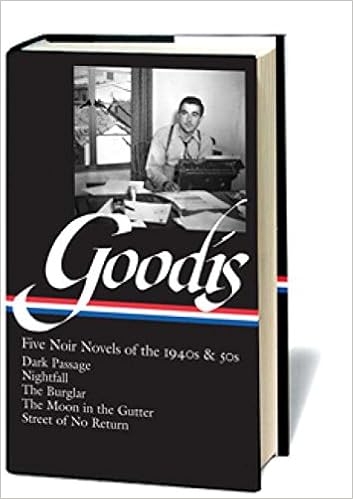
Again, the Library of America and more noir in the form of David Goodis.  I was writing a Philadelphia novel, so Goodis had special appeal since he wrote about Philly. He's a poetic writer whose voice sometimes sinks into pathos, but when he's on target, the books soar.  My favorite: The Moon in the Gutter, a delusional excursion through Philly's poorest neighborhoods, where a man's sister has been murdered.  No spoilers.

Product DetailsConfession:  I'd never read the novels of Raymond Chandler. In 2015, read all of them, and then read them again.  He's the master of atmosphere -- and in The Lady in the Lake, the scents of every setting are haunting.  Pine needles, old carpet, salty air, it's all there.


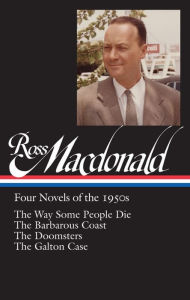
Ross Macdonald: Four Novels of the 1950s: (Library of America #264)

My ever-thoughtful sister sent me a gift of Library of America's Ross Macdonald's Four Novels of the 1950's.  Along with Chandler, Macdonald's another author I'd ignored-- and while Chandler's the master of mood, Macdonald is the master of plot.  His complex, tangled but tight, mysteries must be the best-plotted books ever.  Like everyone, I am in awe of The Galton Case, a novel about guilt that spans generations, and the ever-present prison of family gone awry. 


Another film classic, The Big Clock, led to me to Kenneth Fearing's novel of the same name.  Now, Ray Milland is my idea of the perfect ambiguous hero, and it was such fun to encounter that same moral ambiguity, and witty sophistication in Fearing's novel.  Fearing was a poet, and his facility with imagery really pays off here.  


Related Posts Plugin for WordPress, Blogger...